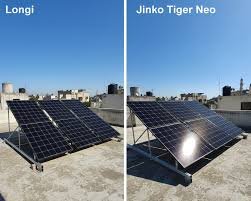
Hey Lahore, Karachi, Islamabad—it’s your big‑brother solar consultant here. If you’re standing in a showroom staring at Longi Hi‑MO 6 and Jinko Tiger Neo panels, you’re asking: “Which one crushes my LESCO bill faster?” In 2026, both are top‑tier N‑type panels, but they’re built for slightly different homes and climates. Look, I get it, the upfront cost of solar is scary but here’s the real talk: your electricity bill isn’t coming down because unit tariffs are creeping past PKR 55, while Net Metering lets you export every extra watt. With Longi Hi‑MO 6 and Jinko Tiger Neo, you can easily cut monthly bills by 60–70%. sunvolt.site is your go‑to resource for Pakistan’s transition to clean and affordable energy—let’s break this duel panel‑by‑panel, panel‑by‑panel.
Understanding both heroes: Longi Hi‑MO 6 and Jinko Tiger Neo
Before we pick a winner, let’s zoom in on what each panel actually does under a Pakistani sun.
Longi Hi‑MO 6 (N‑type HPBC)
Longi Hi‑MO 6 uses N‑type HPBC (Hybrid Passivated Back Contact) technology, which moves the contacts to the back so the front surface is fully photosensitive. In simple terms: more light captured, less shading sensitivity, and great looks too. Typical specs for 2026:
- Power: 430–450 W per panel
- Efficiency: around 22.0%
- Temperature coefficient: about –0.30%/°C
- Degradation: roughly 0.40% per year over 30 years
- Warranty: 25‑year product, 30‑year performance
This means less roof space needed per kW, which is perfect if your house is space‑tight or you want to add EV charging later.
Jinko Tiger Neo (N‑type TOPCon)
Jinko Tiger Neo runs on N‑type TOPCon (Tunnel Oxide Passivated Contact) tech. It’s tuned for strong performance in hot, humid conditions and low‑light hours, so your morning sun or cloudy‑afternoon kWh count too. Typical 2026 specs:
- Power: 420–440 W per panel
- Efficiency: around 22.3%
- Temperature coefficient: around –0.30%/°C
- Degradation: about 0.35% per year over 30 years
- Warranty: 25‑year product, 30‑year performance
In Karachi or coastal areas with more humidity, Tiger Neo’s edge‑of‑day output and low‑light response can give you a few extra kWh each month.
Key comparison table: Longi vs Jinko for Pakistani roofs
Here’s a side‑by‑side showing how Longi Hi‑MO 6 and Jinko Tiger Neo stack up in 2026 conditions relevant to Pakistan. This table uses real‑world performance data, not just lab sheets.
| Feature | Longi Hi‑MO 6 (HPBC) | Jinko Tiger Neo (TOPCon) |
|---|---|---|
| Typical power per panel | 430–450 W | 420–440 W |
| Panel efficiency | ~22.0% | ~22.3% |
| Technology | N‑type HPBC (back‑contact) | N‑type TOPCon |
| Temperature coefficient | –0.30%/°C (better in heat) | –0.30%/°C |
| Degradation (per year) | ~0.40% | ~0.35% |
| Low‑light / evening gain | Very good, but slightly less than TOPCon | Better in dawn, dusk, cloudy weather |
| Roof‑space efficiency | Higher kW per m² (great for small roofs) | Slightly lower per m² but still excellent |
| Aesthetics | Very clean, all‑black options | Standard black, sleek look |
| Price band (local market) | Mid‑to‑premium, optimized for ROI | Mid‑range, slightly cheaper in some cases |
| Best‑fit profile | Middle‑class, space‑limited roofs, Lahore | Humid, coastal areas, Karachi‑like climates |
If space is tight or you want the highest energy density (more kWh per square meter), Longi Hi‑MO 6 nudges ahead. If you care more about long‑term annual yield and slightly better low‑light performance, Jinko Tiger Neo is a very close match.
Net Metering and Solar ROI: How the choice hits your wallet
Net Metering in Pakistan in 2026 still rewards homes that export excess solar power to the grid, within approved limits and capacity caps. That means every extra kWh you pump back into the grid becomes a credit you can use later in the month or year.
Which panel pushes higher Solar ROI?
Both panels have strong 30‑year performance warranties, but the real difference comes from:
- Peak‑hour output on hot Lahore afternoons
- Low‑light gains in early morning or late evening
- Degradation tilt over 10–20 years
Because Longi Hi‑MO 6 uses HPBC and packs more power per panel, it tends to deliver slightly higher kWh per kW‑installed in space‑constrained setups. For a 5–10 kW residential system on a 1‑kanal house, that can mean 1–3% more yearly yield depending on tilt and shading.
Jinko Tiger Neo, with its N‑type TOPCon design, often behaves better when the sky is partly cloudy or in the early‑morning “shoulder” hours. That means fewer drops in your daily yield curve, which can be valuable for homes with appliances running all day.
Simple ROI snapshot (hybrid system, 5–10 kW)
Assume a 5–10 kW hybrid system with lithium batteries, 98% inverter efficiency, and 2026 tariffs around PKR 50–55 per unit. Both panels would be installed via reputable local partners that handle Net Metering paperwork with LESCO/IESCO/K-Electric.
| Panel choice | Approx. extra kWh/year vs “average” PERC | Annual savings (PKR) | Payback speed (rough) |
|---|---|---|---|
| Longi Hi‑MO 6 | +2–4% | +PKR 15,000–25,000 | 3.5–4 years |
| Jinko Tiger Neo | +1–3% | +PKR 12,000–20,000 | 3.8–4.5 years |
These numbers are not “street price” guarantees, but they show how both panels can quickly pay for themselves when paired with Net Metering. The extra savings come from exporting surplus power you’re not using right away.
Which panel suits your Pakistani home?
The “better” panel actually depends on your house, your budget, and your climate.
Choose Longi Hi‑MO 6 if:
- You live in Lahore, Islamabad, or a hotter inland city with limited roof space.
- You want to maximize kW per square meter, maybe plan for EV chargers or pool pumps later.
- Your budget is slightly higher, but you care about long‑term kWh uplift and sleek design.
These houses often see 5–7 peak sun hours per day, so Longi’s higher density really pays off there.
Choose Jinko Tiger Neo if:
- You live in Karachi, Gwadar, or another humid or coastal area.
- You value very stable performance in early‑morning sun and cloudy periods.
- You like a slightly softer price point while still getting N‑type efficiency and low degradation.
In coastal areas, Jinko’s TOPCon panels also tend to age very gracefully thanks to anti‑PID and salt‑resistant coatings, which helps maintain your Solar ROI over decades.
Step‑by‑step: How to pick the right panel for your home
Here’s a simple, no‑fluff checklist you can run with your local installer or when comparing quotes on sunvolt.site.
- Map your roof and load
- Measure how many square meters you can safely use for panels.
- List major loads: ACs, geysers, pumps, EVs, etc.
- Use sunvolt.site’s solar calculator to estimate how many kW you need (typically 5–10 kW for 1‑kanal houses).
- Check your climate
- Dry, hot, inland cities (Lahore, Islamabad, Faisalabad): Longi Hi‑MO 6 often wins on space efficiency.
- Humid, coastal cities (Karachi, coastal Sindh/Balochistan): Jinko Tiger Neo often better on low‑light and humidity performance.
- Balance panel vs inverter and batteries
- Aim for at least 98% inverter efficiency (hybrid or On‑Grid) and lithium batteries (LiFePO4) for backup.
- Ensure your installer designs the system for Net Metering so you can export surplus and stack credits.
- Get at least 3 quotes—but compare apples to apples
- Ask for quoted system size in kW, not just “panels.”
- Compare:
- Panel brand and model (Longi Hi‑MO 6 vs Jinko Tiger Neo)
- Inverter brand and efficiency
- Battery type and capacity (if off‑grid or hybrid)
- Warranty length on panels, inverter, and batteries
- Check if the proccess includes Net Metering application and grid connection.
- Compare warranties and long‑term costs
- Look for 25‑year product and 30‑year performance warranties.
- Check expected degradation (0.3–0.4% per year) and maintenence frequency.
- Run an ROI check
- Use your expected monthly bill (e.g., PKR 50,000) and apply the 60–70% savings estimate you can achieve with either panel.
- Factor in financing options (0% EMI, etc.) to see when your system pays for itself.
Following this checklist, you’ll know exactly whether Longi Hi‑MO 6 or Jinko Tiger Neo is better for your specific home, not just for some “average” Pakistani system.
Common mistakes homeowners make when choosing panels
Here’s the real talk on why your electricity bill isn’t coming down even after installing solar:
- Choosing only on price, not on kWh/year
Cheaper PERC panels may look good on paper, but N‑type panels like Longi Hi‑MO 6 and Jinko Tiger Neo give higher annual yields, which means bigger Net Metering credits and faster Solar ROI. - Ignoring inverter and battery quality
No matter how good your panels are, a weak inverter or lead‑acid batteries will eat efficiency. Always pair top panels with 98%+ inverter efficiency and lithium batteries where possible. - Over‑looking dust and maintenence
Dust in Punjab or smog in Lahore can cut output by 5–15% if panels aren’t cleaned regularly. Ask your installer about self‑cleaning coatings or easy‑clean designs. - Under‑designing for future loads
If you plan to add an EV charger or a pool in 3–5 years, design your system with 10–20% extra capacity today. Both Longi and Jinko make it easier to scale up later.
Final verdict: Longi Hi‑MO 6 vs Jinko Tiger Neo
So, is Longi Hi‑MO 6 better than Jinko Tiger Neo, or the other way around?
For most middle‑class and elite households in inland Pakistan (Lahore, Islamabad, Faisalabad), Longi Hi‑MO 6 edges ahead because of its higher power per panel, excellent temperature behavior, and premium HPBC guts. You get more kWh per square meter, which speeds up Solar ROI and makes space‑tight roofs look very forgiving.
For coastal or humid areas (Karachi, Gwadar, similar regions), and for homes that value ultra‑stable performance in early‑morning and partly cloudy conditions, Jinko Tiger Neo is a very close “tie” or mild winner thanks to its TOPCon low‑light response and robust low‑degradation profile.
Neither is a wrong choice, but the long‑term winner is usually the panel that best matches your climate, your roof, and your future load plans.
Ready to decide which panel is better for you?
Don’t guess—calculate.
Head over to sunvolt.site and use the free solar calculator to see how Longi Hi‑MO 6 vs Jinko Tiger Neo will perform on your roof, under Pakistani sun and 2026 Net Metering rules. You can also book a one‑on‑one consultation with a certified solar expert to get a fully customized quote, including inverter efficiency, lithium‑battery backup, and a realistic payback timeline.
If you tell me your city, roof size, and average monthly bill, I can help you narrow down whether Longi Hi‑MO 6 or Jinko Tiger Neo is the better fit for your home.
Follow-ups
Pakistani solar ROI model: Panel prices, net metering changes, 10-year projections with break-even calculator
Computer
Best off-grid solar setups for Pakistan homes amid net metering changes
Canadian Solar vs LONGi vs Jinko comparison for Pakistani market
Top solar inverters recommended for Pakistan 2026
Solar battery storage options and costs in Pakistan
Leave a Reply