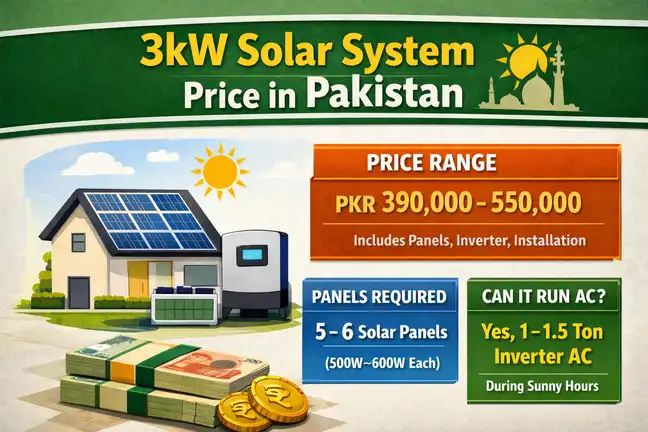
If you’re thinking about installing solar in Pakistan, one of the most common questions is:
👉 How much can you save with a 3kW solar system?
And honestly, this is the right question to ask before investing.
Because a 3kW system is one of the most popular choices for small to medium households in Pakistan — especially for families trying to escape rising electricity bills.
This guide will break down monthly savings, real-world output, Net Metering benefits, and ROI calculations so you know exactly what to expect in 2026.
Look, I get it, the upfront cost of solar is scary but… monthly electricity bills that keep increasing are even scarier in the long run.
Let’s break it down properly.

What Can a 3kW Solar System Power?
A 3kW solar system is considered a small-to-medium residential setup.
It can typically run:
- 2–3 ceiling fans
- 6–8 LED lights
- 1 refrigerator
- WiFi router + TV
- Small water pump (limited use)
Not ideal for:
- Heavy AC usage
- Large industrial loads
Here is the real talk about why your electricity bill isn’t coming down: most homes underestimate how much basic appliances still consume daily.
Daily Energy Production of a 3kW System in Pakistan (2026)
Pakistan has excellent solar potential.
Average output:
- 1kW system = 4–5 units/day
- 3kW system = 12–15 units/day
Monthly production:
👉 360 to 450 units per month
This depends on:
- Weather conditions
- Dust levels
- Inverter efficiency
- Panel orientation
Monthly Savings with a 3kW Solar System
Now let’s calculate real savings.
Electricity tariff in Pakistan (average 2026):
- PKR 45 – 60 per unit (varies by slab)
Monthly generation:
- 400 units (average)
Savings calculation:
400 units × PKR 50 = PKR 20,000/month savings
Final Monthly Savings Estimate
Conservative scenario:
- PKR 12,000 – 15,000/month
Average scenario:
- PKR 15,000 – 20,000/month
High efficiency (Net Metering optimized):
- PKR 20,000 – 25,000/month
ROI Table: 3kW Solar System in Pakistan
| Factor | Value (Approx) |
|---|---|
| System Size | 3kW |
| Monthly Savings | PKR 15,000–20,000 |
| Yearly Savings | PKR 180,000–240,000 |
| Payback Period | 2.5 – 4 years |
| System Lifespan | 20–25 years |
Role of Net Metering in Increasing Savings
Net Metering is a game-changer in Pakistan.
Benefits:
- Export extra electricity to grid
- Reduce bill to near zero
- Earn credits for surplus energy
Example:
If your system produces extra 100 units/month:
- You get billed less OR credited
This is why many users achieve higher savings than expected.
System Types Impacting Savings
1. On-Grid System (Recommended)
- No batteries required
- Highest ROI
- Best for Net Metering
2. Hybrid System
- Includes Lithium batteries
- Backup during load-shedding
- Higher initial cost
3. Off-Grid System
- Fully battery dependent
- Expensive per unit energy
Comparison Table: System Types & Savings
| System Type | Monthly Savings | ROI Speed | Best For |
|---|---|---|---|
| On-Grid | High | Fast | Urban homes |
| Hybrid | Medium | Medium | Backup needs |
| Off-Grid | Low | Slow | Remote areas |
Impact of Inverter Efficiency on Savings
Modern inverters (2026 models) significantly affect performance.
High-efficiency inverter benefits:
- Better energy conversion
- Less power loss
- Stable output
Low-quality inverter:
- 5–10% energy loss
- Reduced monthly savings
Lithium Batteries & 3kW Systems
If you choose hybrid systems:
Lithium battery benefits:
- Fast charging
- Long lifespan
- Efficient backup
But:
- Increases upfront cost
- Not necessary for pure Net Metering systems
Factors That Increase or Decrease Savings
Increase savings:
- Proper panel orientation
- Regular cleaning
- High-efficiency inverter
- Net Metering approval
Reduce savings:
- Dust accumulation
- Shading issues
- Poor wiring
- Low-quality installation
Yes, maintenence plays a major role in long-term savings.
Real-World Example (Pakistan Household Case)
Household setup:
- 3kW system
- Lahore-based family
- 1 fridge, fans, lights
Monthly bill before solar:
- PKR 18,000 – 25,000
After solar:
- PKR 2,000 – 5,000 (mostly fixed charges)
👉 Savings: 80–90%
Step-by-Step Guide to Maximize 3kW Solar Savings
Step 1:
Install proper south-facing panels
Step 2:
Use high-efficiency inverter
Step 3:
Apply for Net Metering
Step 4:
Avoid shading on panels
Step 5:
Clean panels regularly
Let’s simplify the proccess: good design = maximum savings.
Middle-Class vs Elite Usage Strategy
Middle-Class Homes:
- 3kW system for essential load
- Focus on bill reduction
Elite Homes:
- Larger systems (5–10kW)
- Hybrid + battery backup
- Maximum independence
Common Mistakes That Reduce Savings
Let’s avoid expensive errors.
1. Undersizing system
Leads to low savings.
2. Ignoring Net Metering
Biggest missed opportunity.
3. Cheap installation work
Reduces long-term performance.
4. Poor panel placement
Reduces daily output significantly.
Future of 3kW Solar Systems in Pakistan (2026+)
Solar technology is improving rapidly:
- AI-based load optimization
- Smart Net Metering integration
- Higher efficiency panels (600W+)
Even small systems like 3kW will become more powerful in coming years.
Final Thoughts: Is a 3kW Solar System Worth It?
Short answer: Yes — absolutely.
Long answer:
A 3kW solar system is one of the most cost-effective ways for Pakistani households to reduce electricity bills. With proper design and Net Metering, it can significantly reduce or even eliminate monthly bills.
Your not just buying panels — you’re investing in long-term energy independence and financial relief.
And if you want expert system sizing, savings calculation, and installation guidance, sunvolt.site is becoming Pakistan’s trusted platform for solar education and renewable energy solutions.
Call to Action
Don’t let rising electricity prices control your budget.
Visit sunvolt.site today to calculate your solar savings, explore 3kW system designs, and connect with certified solar experts in Pakistan.
Take action now — install solar, reduce your monthly bills, and unlock long-term savings with clean energy.
Leave a Reply